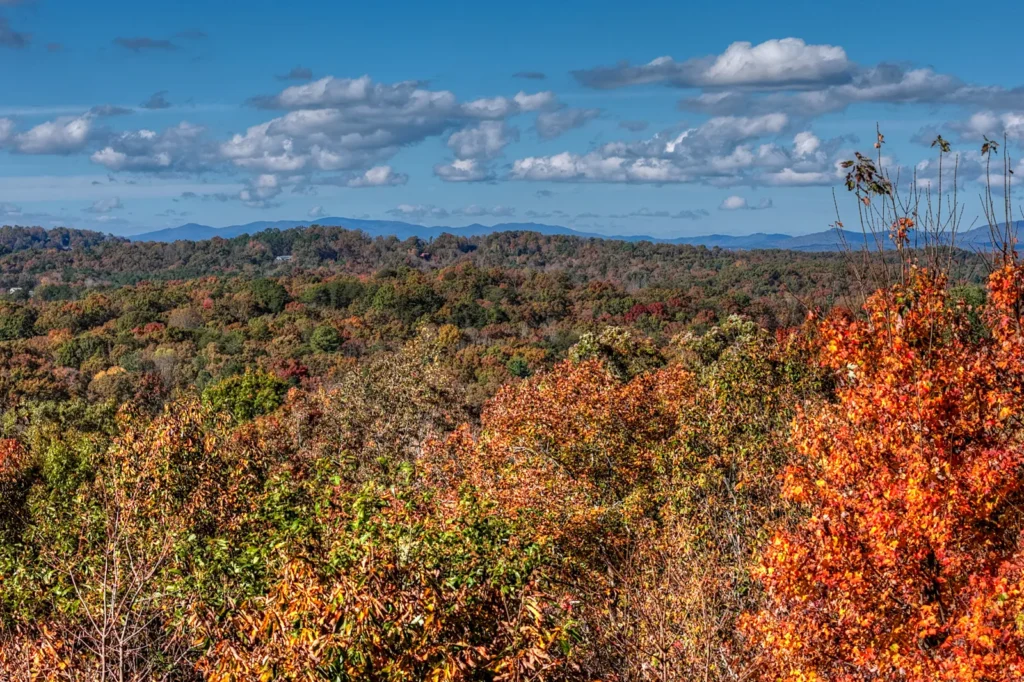
Blue Ridge Mountains vs. Smoky Mountains is usually a choice between two bases: North Georgia, around the town of Blue Ridge, and the Smokies, around Gatlinburg and Pigeon Forge, Tennessee.
On a map, the Smokies are one section of the Blue Ridge range. As trips, they’re very different, and the choice mostly comes down to how far you want to drive and what you want to do once you arrive.
Quick answer
Blue Ridge, GA is the shorter drive from Atlanta. The Smokies win for a national park, big peaks and Pigeon Forge attractions.
| Best for | Pick | Why |
|---|---|---|
| A weekend from Atlanta | Blue Ridge, GA | About 1 hr 45 min to 2 hours from Atlanta, versus about 4 to 4.5 hours to Gatlinburg |
| Couples | Blue Ridge, GA, unless big hikes are the point | A short drive from Atlanta and easy days on the scenic train, the Toccoa River and Lake Blue Ridge. Pick the Smokies if long trail days and high peaks matter most |
| Families with young kids | Blue Ridge, GA, unless Dollywood is the point | A shorter car ride from Atlanta and the scenic train. Pick Gatlinburg and Pigeon Forge if Dollywood and dinner shows are the trip |
| A first national park trip or big hikes | The Smokies | Great Smoky Mountains National Park, Kuwohi at 6,643 ft and 848 miles of park trail |
| Hiking with your dog | North Georgia | The Smokies allow leashed pets on only two trails; North Georgia gives you far more trail options with a leashed dog |
| Doing both | Split the stay | The two towns are about 117 miles and about 3 hours apart |
The weekend, couples and family picks are our judgment for an Atlanta start; from elsewhere, compare your own drive to each town. The park, dog and split-stay rows hold from anywhere.
Georgia Cabins for YOU rents cabins in North Georgia, so the park, forest and fee facts below come from official sources, and the Smokies get credit where they win.
Blue Ridge vs. Smoky Mountains at a glance
The Smokies win on height, national park access and attractions. North Georgia wins on drive time from Atlanta and trail options with a dog.
| Blue Ridge, GA and North Georgia | Gatlinburg, Pigeon Forge and the Smokies | |
|---|---|---|
| What it is | The Georgia end of the Blue Ridge; the town sits in the Chattahoochee National Forest | A section of the Blue Ridge, centered on a national park |
| Highest peak | Brasstown Bald, 4,784 ft (Georgia’s highest) | Kuwohi, 6,643 ft (highest in the park and in Tennessee) |
| Main public land | Chattahoochee-Oconee National Forests and Georgia State Parks | Great Smoky Mountains National Park |
| Trail network | About 850 miles of recreation trails across the Chattahoochee-Oconee National Forests, which also include Piedmont land outside the mountains | 848 miles of trail in the park |
| Drive from Atlanta | About 1 hr 45 min to 2 hours | About 4 to 4.5 hours |
| Fees (as of November 2026) | State parks: $10 per vehicle per day or $70 annual ParkPass. Brasstown Bald: $10 per adult 16 and up, free for 15 and under | No entrance fee. Parking tag for stops over 15 minutes: $5 daily, $15 weekly, $40 annual |
| Dogs on trails | Leashed dogs welcome in Georgia State Parks, with listed exceptions; leash or restraint required in national forest developed sites | Leashed pets allowed on only two park trails |
| Crowds | No comparable regional visitor count | 11,527,939 recreation visits in 2025, the most of any national park |
| Base towns | Blue Ridge and nearby North Georgia towns | Gatlinburg and Pigeon Forge |
| Best for | Short trips from Atlanta, train, river and lake time, hiking with a dog | First national park trips, high-peak hikes, attraction-heavy family trips |
Fees and rules change, so check the official pages linked below before you go. Cabin prices aren’t in the table; compare rates for your own dates on each side.
How far is each from Atlanta?
Blue Ridge, GA is less than half the drive. Here is how the three legs compare:
| Route | Distance | Drive time |
|---|---|---|
| Atlanta to Blue Ridge, GA | About 90 miles | About 1 hr 45 min to 2 hours |
| Atlanta to Gatlinburg, TN | About 200 to 250 miles, depending on route | About 4 to 4.5 hours |
| Blue Ridge, GA to Gatlinburg, TN | About 117 miles | About 3 hours |
All three times come from one Google Maps check with live traffic on a weekday afternoon in November 2026. Yours will vary with traffic, route and when you leave.
In that check, Blue Ridge, GA was roughly two and a half hours closer to Atlanta each way, which adds up to more than four hours over a round trip.
Our judgment: that gap matters most on a two- or three-night trip, when a long drive takes up a real share of your time in the mountains. On a week-long stay, it matters less.
Hiking and mountain views
The Smokies have the bigger peaks and more trail in one park. North Georgia is the closer hiking trip from Atlanta and the easier one with a dog.
The Smokies
The park’s high point is Kuwohi, formerly called Clingmans Dome. At 6,643 feet, it’s the tallest mountain in the park and in Tennessee, per the NPS. The name was restored in 2024, so older maps and guides may still say “Clingmans Dome.”
The park covers about 522,000 acres, split almost evenly between Tennessee and North Carolina, with 848 miles of trail, according to the NPS park statistics.
For a slower day, Cades Cove is an 11-mile, one-way loop road, and the NPS says to allow at least two to four hours. The loop is typically closed to cars on Wednesdays from May through September, so check the current schedule first.
North Georgia
Georgia’s high point is Brasstown Bald, at 4,784 feet, in the Chattahoochee-Oconee National Forests near Blairsville, Hiawassee and Helen.
According to the U.S. Forest Service, a shuttle runs to the summit and three trailheads start from the parking lot. Our guide to the highest point in Georgia covers the visit.
Springer Mountain is the southern end of the Appalachian Trail, per the Georgia Encyclopedia. If you want to hike a piece of it, see our guide to the Appalachian Trail in North Georgia.
Closer to town, Blue Ridge sits within the Chattahoochee National Forest. Our list of the best Blue Ridge hikes is the place to start.
How the two compare for hikers
Kuwohi stands about 1,860 feet taller than Brasstown Bald. If summits and long trail days are the point of your trip, pick the Smokies.
On total trail miles, there’s no clean winner. The Forest Service lists about 850 miles of recreation trails across the Chattahoochee-Oconee National Forests, but that total also covers Piedmont land in central Georgia, outside the mountains. It doesn’t compare directly with the park’s 848 miles.
What North Georgia offers instead is hiking that’s quicker to reach from Atlanta, with many more trails open to a leashed dog. More on dogs below.
Why the Smokies look smoky
The blue haze over the Smokies isn’t smoke. According to the NPS, plants in the forest release natural compounds that react in sunlight and moisture to form tiny particles, and those particles scatter blue light.
Things to do: Blue Ridge, GA vs. Gatlinburg and Pigeon Forge
These two bases lead to very different days. Blue Ridge, GA is built around a train, a river and a lake. Gatlinburg sits beside the most visited national park in the country, with Pigeon Forge’s attractions just up the road.
Blue Ridge, Georgia
Explore Georgia, the state tourism office, describes Blue Ridge as tucked in the Chattahoochee National Forest at the edge of the Appalachian Trail, about 90 miles north of Atlanta via I-575.
The Blue Ridge Scenic Railway leaves from the historic downtown depot and follows the Toccoa River on a 26-mile round trip. There are two-hour and four-hour options, and riders can step off in McCaysville, Georgia, or Copperhill, Tennessee.
Our Blue Ridge Scenic Railway guide covers the ride. Explore Georgia also lists paddling on Lake Blue Ridge, so a weekend can mix the train, time on the water and a hike without much driving.
For the rest of the town, from downtown to day trips, see our Blue Ridge, GA guide. To see more of the region, our North Georgia mountains guide covers the nearby towns.
Gatlinburg and Pigeon Forge
Gatlinburg’s tourism office calls it the “Gateway to the Smokies,” and that is the appeal: the national park starts at the edge of town.
Pigeon Forge, just north on US 441, is the attraction side of the trip. Its tourism office lists Dollywood and dinner shows among the main draws.
That’s the strength of a Smokies base. You can spend the morning in the national park and the evening at a show. If that’s the trip you want, browse Gatlinburg cabin rentals.
Crowds and fees
The Smokies are measurably busy, and both trips come with some parking or admission costs.
Crowds
Great Smoky Mountains National Park recorded 11,527,939 recreation visits in 2025, the most of any national park, according to the NPS 2025 visitation release. Recreation visits count trips into the park, not unique people.
North Georgia’s mountains are spread across national forest, state parks and several towns, and no single visitor count covers them in a comparable way. That means there’s no fair crowd number to put beside the Smokies, not that North Georgia is empty.
Our judgment, not a measurement: a gateway town beside a park with that many visits will be busy, so plan for traffic and full parking areas in the Smokies, especially on popular weekends.
Fees
As of November 2026, Great Smoky Mountains National Park charges no entrance fee. You do need a parking tag to park for more than 15 minutes: $5 daily, $15 weekly or $40 annual, per the NPS fees page.
On the Georgia side, Georgia State Parks charge $10 per vehicle per day, or $70 for an annual ParkPass, which isn’t valid at state historic sites. Brasstown Bald charges $10 per adult 16 and up, and kids 15 and under get in free.
These are planning costs, not a verdict on which trip is cheaper. Your total will depend far more on your cabin and how many nights you stay.
Which is better with a dog?
North Georgia, by a wide margin, if you want to hike together. You’ll have far more trail options with a leashed dog.
In the Smokies, pets are allowed in campgrounds, picnic areas and along roads, but only two trails allow leashed pets: the Gatlinburg Trail and the Oconaluftee River Trail, per the NPS pets page.
In Georgia, state parks welcome dogs on a leash of six feet or less, according to the Georgia State Parks rules. Dogs aren’t allowed in park buildings, lodges, yurts, group camps, swimming areas or beaches, or on some trails at Panola Mountain and Tallulah Gorge.
In the Chattahoochee-Oconee National Forests, the Forest Service requires pets to be restrained or on a leash in developed recreation sites, and pets other than guide dogs aren’t allowed in swimming areas.
Rules can differ by site, so check the posted rules at each trailhead before you set out.
Can you do both on one trip?
Yes. Blue Ridge, GA to Gatlinburg is about 117 miles, about 3 hours in the same weekday-afternoon Google Maps check, so a split stay is realistic.
A simple plan is a few nights in each base: the train, river and lake in Blue Ridge, then the national park and Pigeon Forge from Gatlinburg. Starting in Blue Ridge also puts the shorter leg at the front of the trip if you’re coming from Atlanta.
Seasons matter on both sides, so check Blue Ridge weather by season before you pick dates.
Aren’t the Smokies part of the Blue Ridge?
Yes. The Great Smoky Mountains are one section of the Blue Ridge, and the Blue Ridge is part of the larger Appalachian Mountains.
The NPS describes the Blue Ridge Province as a mountain belt running from Pennsylvania southwest to Georgia, and it includes the Great Smokies on the Tennessee and North Carolina line. So “Blue Ridge vs. Smoky Mountains vs. Appalachian Mountains” isn’t three rival ranges. Each sits inside the next.
“Blue Ridge” also gets used three ways:
- The range: the belt from Pennsylvania to Georgia, Smokies included. The Georgia Encyclopedia says it reaches almost 100 miles into Georgia.
- The Blue Ridge Parkway: a 469-mile road in Virginia and North Carolina that ends at the Great Smokies in North Carolina, per the NPS Parkway page. It does not enter Georgia.
- The town of Blue Ridge, Georgia: the North Georgia base compared in this article.
Because the range runs through several states, there’s no single “best” Blue Ridge state. The better question is which section fits your trip.
Blue Ridge vs. Smoky Mountains FAQ
Is Blue Ridge, GA in the Smoky Mountains?
No. Blue Ridge, Georgia is in the North Georgia mountains, part of the Blue Ridge range. The Smokies are a different section of that range, on the Tennessee and North Carolina border. Gatlinburg, at the edge of the Smokies, is about 117 miles from Blue Ridge, GA by car.
Is the Blue Ridge Parkway in Georgia?
No. The Blue Ridge Parkway is a 469-mile road in Virginia and North Carolina that ends at the Great Smoky Mountains in North Carolina, according to the NPS.
Its high point is 6,053 feet at Richland Balsam, North Carolina. Blue Ridge, Georgia shares the name of the mountain range, not the road.
Which is higher, the Blue Ridge or the Smoky Mountains?
The Smokies are higher than the Georgia section of the Blue Ridge. Kuwohi, the Smokies’ high point, is 6,643 feet. Brasstown Bald, Georgia’s highest peak, is 4,784 feet.
Which is closer to Atlanta?
Blue Ridge, GA. It’s about 90 miles from Atlanta, about 1 hr 45 min to 2 hours by car. Gatlinburg is about 200 to 250 miles, about 4 to 4.5 hours. Both times come from a weekday-afternoon Google Maps check in November 2026 and vary with traffic and route.
The bottom line
Pick the Smokies for a national park, Tennessee’s highest peak and big attraction days. Pick Blue Ridge, GA for a shorter drive from Atlanta, a train, river and lake base, and more trails you can hike with your dog.
If Blue Ridge fits your trip, browse our Blue Ridge, GA cabins.